
Data Center
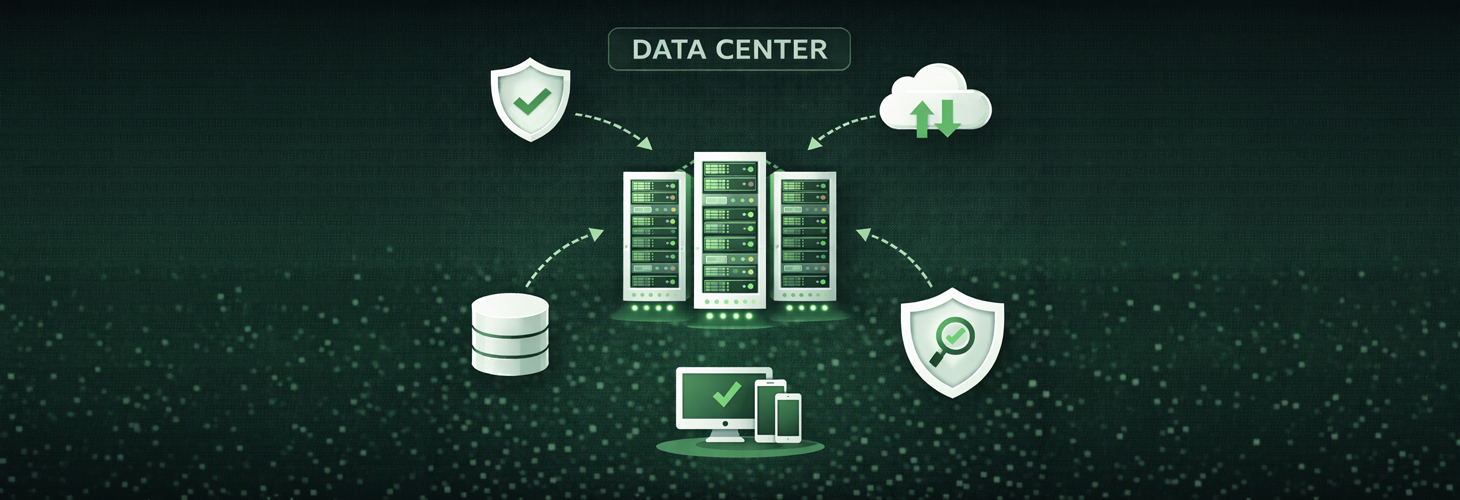
A data center (also known as a computing center or IT center) describes a building or a room where all the computing technology of a company can be found. Depending on the size of the company, the data centers may be spread across different buildings, countries, and continents. In smaller installations, this center may simply be a server room or a server cabinet or IT cabinet.
A data center consolidates IT resources and has the task of processing large amounts of data, as is the case with financial administrations, universities, or search engines. To ensure that data processing functions smoothly and computer failure is avoided, all the necessary components and systems for operation are usually available in multiple copies. If a device fails, the backup immediately steps in and continues data processing safely.
Special requirements for a data center
Setting up a data center requires a lot of organization and planning within a company, as the sensitive server technology needs to be properly protected. After all, countless processes depend on a smooth IT infrastructure. Typically, a data center consists of two rooms. The so-called security room houses the IT systems, while the second room is intended for the organizational technology maintenance of the computers. This includes, among other things, air conditioning, power supply, and fire suppression systems. Specifically, the cooling of computers is a crucial aspect in the planning of a data center. Due to the high performance density of the computers, there is significant heat generation, which can lead to overheating, equipment failure, or fires. Since the computers draw in cold air at the front and expel warm air at the back, air-conditioned air is let out from the floor at the front and drawn in again at the back.
Because not only can heat generation or a short circuit hinder data processing, but also radiation, pressure waves, and human influence, the topic of security plays an important role in a data center. Many data centers are constructed underground in the form of a bunker, which keeps pressure waves or ionizing radiation from affecting the data center. Access is controlled and only possible for external persons under supervision. Furthermore, special extinguishing systems are deployed in case of a fire, as conventional extinguishing agents can cause more damage to a computer than a short circuit. Halons are often used to safely extinguish fires.
Power consumption and energy efficiency: complex operation
In 2011, approximately 52,000 German data centers reportedly had a power consumption of 9.7 terawatt-hours. About half of the electricity was not used for the computers but was instead used for cooling or emergency power supply. For many people, data centers are criticized for consuming too much electricity in operation or for being inefficiently designed. According to its own statements, the company Google strives for more energy efficiency in its own data centers and simultaneously supports each data center in operating more efficiently with best practices.
Companies with cloud or data center?
As an alternative to the data center, the cloud has gained increasing importance for IT infrastructure in companies in recent years. This is where the so-called cloud software (web app) also comes into play. Although both serve similar purposes, there are a few differences. The data center is a central and physical facility, whereas the cloud stores data virtually. The data center is accessible only at one location, while the cloud is accessible from anywhere with an internet connection. However, this also means you are dependent on that connection. A cloud storage also allows for less control, whereas a data center offers more security. On the other hand, the physical IT center is significantly more expensive and difficult to scale. Both options have their advantages and disadvantages. Hybrid solutions are also possible for storing data. In any case, IT security is always a crucial factor in both solutions.