
Shopware 5 end of life: The clock is ticking
On 31 July 2024 Shopware ended support for Shopware 5. That means there are no more security updates. Every Shopware 5 shop becomes a security risk – and gradually loses its competitiveness.
Migration is unavoidable. The question is not if, but where to.
And this decision is expensive: choosing the wrong platform will cost you a lot of money – not only in the migration, but especially in ongoing operating costs, lost rankings and limited scalability.
 "Zoran Artmagic")
Over the last 16 years I have supported more than 200 e‑commerce projects – on Shopware 5, Shopware 6, Shopify, Magento. I know where the stumbling blocks are. And I know what agencies like to keep quiet about.
The 5 biggest mistakes in the platform decision
1. Underestimating migration costs
Most merchants calculate 15,000 – 40,000 € for a standard migration. That is the tip of the iceberg. What many forget: data transfer and possibly data cleansing (old customer data, product data, order history), template adjustments (transferring your design 1:1 never works), interface integration (ERP, merchandise management, payment, shipping), training effort (your team has to learn the new system), go‑live buffer (it never runs perfectly the first time). With complex multi‑shop or B2B systems, high costs are not uncommon. Shopify seems cheaper in migration – but the hidden costs come later.
2. Ignoring SEO risks
A platform change is a high‑risk SEO project. Anyone who does not migrate their URLs cleanly loses rankings that have been built up over years. I have seen shops that lost 40% of their organic traffic after a migration – and needed over 12 months to recover. Shopify offers less flexibility with URL structures and technical SEO. While Shopware 6 offers very high technical control and flexibility, certain SEO adjustments are only possible in Shopify via apps or workarounds. The problem: in practice these limitations often only become apparent months after launch, when organic visibility has already collapsed.
3. Underestimating B2B requirements
Shopify has massively expanded its B2B functions in recent years (especially in Shopify Plus). For simple B2B processes that is often enough. But: complex B2B processes – multi‑level approvals, complex price matrices, individual catalogues per customer, customer‑specific tiered pricing – require additional apps or custom development in Shopify. Shopware 6 offers these functions natively. If you are serious about B2B, you should know the platform limits very well – before you migrate.
4. Underestimating multi‑shop costs
This is one of the biggest cost traps. In Shopware 6, multi‑shop is possible from the Rise edition (from 600 € / month). One central system, multiple shops, fully independent. In Shopify Plus (from 2,300 USD / month), so‑called "expansion stores" are included – but they share product catalogues and the design system. For real multi‑brand scenarios (separate brands, completely own assortments, different design systems), you often need several Plus licences with Shopify – and then it gets expensive. Example: three independent brands with their own assortments? With Shopware Rise: 600 € / month. With Shopify: probably 3× Plus licences = 6,900 USD / month. In such scenarios this can quickly make the difference between 7,200 € and 82,800 € per year.
5. Ignoring ongoing costs
Migration is a one‑time pain. Ongoing costs are the decisive factor. With Shopify you get: transaction fees (0.5 – 2% with external payment providers such as PayPal, Giropay, PostFinance, Ratepay – with Shopify Payments these are waived), apps (200 – 2,500 € / month, depending on the range of functions), SEO/SEA additional costs (in our project experience often 400 – 2,500 € / month, because technical SEO limitations have to be compensated by more paid ads), development costs (customisations are more expensive with SaaS systems than with open‑source systems). The total cost of ownership (TCO) over 3 years is decisive – not the list price in the first year.
The comparison with concrete figures
This report shows both systems without system preference. arboro has been both a Shopware Gold Partner and a Shopify Partner for over 16 years. We have implemented over 200 projects on both platforms – and know exactly where the strengths and weaknesses lie.
 "Vergleich Shopware 6 oder Shopify")
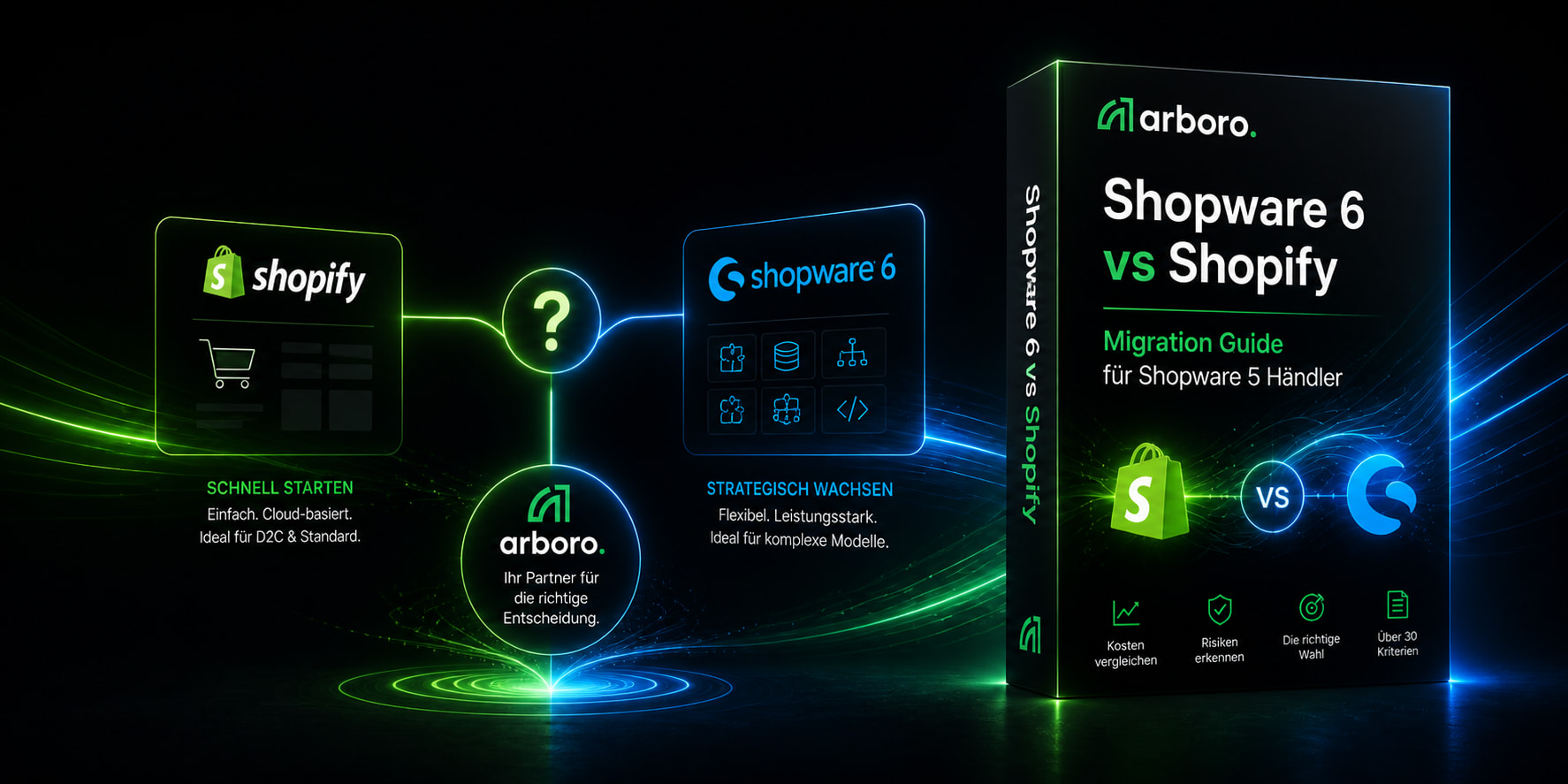
Shopify is fast, simple and scalable – ideal for standard D2C commerce. Shopware 6 is flexible, powerful and future‑proof – ideal for complex business models. The right choice depends on your business model, your company size and your strategic goals.
The decision should always be made along three factors:
Only if all three factors are taken into account is the decision sustainable.
What you get in this 41‑page migration guide:
1. Migration costs in detail
Concrete reference values for small migrations (15,000 – 40,000 €), medium migrations (40,000 – 80,000 €) and large migrations (80,000 – 200,000+ €). With all hidden costs: data cleansing, template adjustment, interfaces, training, go‑live support. No marketing figures. Real project experience from 200+ shops.
2. Direct comparison: 41 criteria
SEO flexibility, performance, multi‑shop, B2B functions, app ecosystem, development costs, hosting requirements, payment fees, template flexibility, internationalisation and more – compared side by side. Shopware 6 vs. Shopify – based on real project experience.
3. Three concrete cost scenarios
For shops with €1,000 / month, €100,000 / month and €1 million / month in revenue. With Shopware Community Edition, Rise, Evolve – and Shopify Basic, Plus, Enterprise. Including: hosting, apps, transaction fees, development, additional SEO/SEA costs. The TCO calculation that nobody does – but everyone should.
4. Additional SEO/SEA/GEO costs with Shopify
The hidden cost factor that no Shopify agency talks about. In our project experience, often: €400 – €2,500 / month more SEO budget (because technical flexibility is lacking), more SEA budget (because it’s harder to maintain organic visibility), more GEO optimization (because manual adjustments are necessary). That’s €4,800 – €30,000 per year – which nobody factors into the migration calculation.
5. Multi-shop & B2B limits
When Shopify is structurally not a fit: multi-brand operations without shared product catalogs, complex B2B processes with multi-level approvals, customer-specific price lists with complex matrices, individual catalogs per customer group. Including: workarounds – and their costs.
6. Ongoing operating costs
The Total Cost of Ownership (TCO) over 3 years: hosting, licenses, apps, payment fees, maintenance, development, additional SEO/SEA costs. Shopware vs. Shopify – with all hidden costs. The calculation you should do before making your decision – not 12 months afterwards.
7. Performance & SEO flexibility
Technical comparison: Core Web Vitals, server-side rendering, URL control, canonical tags, structured data, headless capability. Where Shopware 6 is technically ahead – and where Shopify scores points.
8. Quick decision matrix
Why arboro? Multi-platform partnerfor over 16 years
arboro is one of the fewfull-service agencies in Germany that offers shop development, shop support and maintenance as well as professional online marketing from a single source – as aShopware Gold Partner,Shopify Partner,Google Premium Partner andTop 100 SEO service provider.
This means: we earn money with both platforms – and therefore have no hidden agenda. Our recommendation is based solely on your business model, not on our platform preference.
Frequently asked questions about the Shopware 5 migration
Technically yes – but it’s a security risk. Without security updates, your shop becomes vulnerable to hacker attacks. In addition, you gradually lose competitiveness because modern features are missing. My recommendation: migrate within the next 12 months.
Small: €15,000 – €40,000. Medium: €40,000 – €80,000. Large: €80,000 – €200,000+. Depending on: amount of data, template complexity, interfaces, individual customizations. Anyone who promises you a flat “€25,000” has either not taken all factors into account or is calculating too optimistically. And if the agency has miscalculated, the collaboration becomes unpleasant: every additional requirement suddenly costs extra, deadlines slip, completion is at risk – because the agency cannot absorb the loss economically. In the end, you pay twice: once in money, once in nerves.
In the short term yes – the migration is often cheaper. In the long term no – ongoing costs rise due to transaction fees, apps and additional SEO costs. The TCO over 3 years is the deciding factor.
Not if the migration is carried out professionally: 301 redirects for every old URL, detailed URL mapping, correctly setting canonical tags, migrating structured data, monitoring Search Console. Shopware 6 offers more control here than Shopify – but both can do it if it’s done properly.
To a limited extent. Basic B2B functions (customer-specific prices, net prices, purchase on account) work without any problems. Complex processes (multi-level approvals, complex tiered pricing, individual catalogs per customer) require additional apps or custom code with Shopify. Shopware 6 is more flexible here – especially if you have many B2B customers with different requirements.